Wednesday, January 28, 2026

January 28, 1947: The Lay Abortionist

Twenty-nine-year-old waitress Kerneda Bennett, though living with her husband in Harrisonburg, Virginia, got pregnant as a result of an extramarital affair in late 1946. She asked her friend, Irene Davis, to help her arrange an abortion. Irene called her friend, Iva Rodeffer Davis Coffman, to make arrangements. At around the end of the first week of January, 1947, Kerneda and Irene went to Coffman's home at Mt. Crawford, near Harrisonburg.  

Coffman took Kerneda into a bedroom. "When they came out," according to legal records, "Mrs. Coffman told Mrs. Bennett to come back if nothing had happened in fourteen days, and if anything was said about why they were there to say they came to have a dress made."

Grok AI illustration
About two weeks later, on January 27, Kerneda "had not had the result expected." She asked Irene to contact Coffman again. The two of them took a taxi back to Coffman's home about 7:30 on the evening of January 28. While the taxi was waiting, Coffman took Kerneda back into the bedroom. About fifteen or twenty minutes later Irene thought she heard something fall. A few minutes later, Coffman told her that Kerneda had fainted and asked her to come back to the bedroom. Irene found Kerneda lying, groaning, face-down on the floor beside the bed, dressed except for her shoes and coat. 

Coffman seemed very nervous and said that they needed to get Kerneda to a hospital. Irene summoned the taxi driver, who carried Kerneda out to the cab. Kerneda, who had been nearly lifeless when loaded into the taxi, was dead on arrival at the hospital.

That night Coffman's home was searched, but nothing of evidential value was found. Coffman told the sheriff that Kerneda had asked to use the bathroom, and was shown to the bedroom, and asked for a glass of water. Coffman said she'd brought Kerneda the water, which she had used to wash down two pills from her purse, joking that they were poison. A few minutes later, Coffman said, Kerneda fell onto the floor.

The Harrisonburg/Rockingham County coroner, Dr. Byers, performed the autopsy assisted by Dr. Hill. They found no evidence of external injuries except for a small genital scratch. A piece of tissue from the placenta was in the cervix, a small blood clot was in the vagina, and the uterus was in place, appearing at first to be a normal pregnant uterus with no signs of injury. Upon removing the uterus, the doctors noted a sensation as if the organ contained air. They opened the uterus and found an intact pregnancy with a fetus of about three to four months of gestation. Byers concluded that an abortion had been attempted, which had caused a fatal air embolism. After the embolism killed Kerneda, the baby died as well. He based the embolism diagnosis on the crepitation (feeling as if air was present) of the uterus. Coffman was convicted of performing the fatal abortion and incarcerated to serve a five year sentence. 

According to genealogy records, Kerneda had a daughter who was about nine years old at the time of her mother's death.

Watch The Dressmaker Abortionist? on YouTube.

Sources:

January 28, 1918: Another Pittsburgh Slippery Elm Death

West Penn Hospital
My primary information about abortion deaths for this time and place are through coroner records. Interestingly, the Pittsburgh area's abortion culture seemed to lean toward self-induced abortions despite the presence of physician-abortionists.

On January 28, 1918, 27-year-old Annabella Lewis, a homemaker, died in at West Penn Hospital in Allegheny County, Pennsylvania. The autopsy concluded that she had performed a self-induced abortion using slippery elm bark. She had told her husband, Albert, about the abortion, but had denied even being ill to anybody else until her admission to the hospital.

According to census records, Annabella and her husband had a son, Joseph, who would have been about ten years old at the time of her death. She was a native of Pennsylvania.

Watch Slippery Elm in Pittsburgh on YouTube.

January 28, 1943: Doctor Borrows Name, Kills Patient

 Dr. Henry Gross, age 56, had a reputable medical practice at 843 Belmont Avenue in Chicago in the 1940s. However, after a Dr. Ira Willits died, Gross purchased the dead man's office and set up an abortion practice there under Willits's name.

According to Olga Perez, in January of 1943, her daughter-in-law 22-year-old Lavern Perez went to "Dr. Willits" at 530 North Clark Street for an abortion. Mrs. Perez said that Lavern had paid an office attendant $60 for the abortion. 

Lavern died in her Chicago home on January 28.

The day Lavern died, Mrs. Perez said, Dr. Gross appeared at her home with a gun, which he used to threaten both her and her son. They wrestled the gun away from him, whereupon he begged for the weapon back so he could kill himself. 

Gross had insisted that he'd only been treating Lavern for a cold. However, he was also investigated for the February 26, 1943 abortion death of 20-year-old waitress Dorothy Webber.

A jury of eight women and four men found Gross guilty of manslaughter by abortion in Lavern's death. He won a new trial on the grounds that the state used prejudicial evidence. 

The trail ends there. I've been unable to find out the outcome of the second trial, and Gross doesn't show up again on census records or, as far as I can find, death records.

Watch Abortionist and Dead Women Vanish on YouTube.

Sources:


January 28, 1974: Five Children Left Motherless

Grok AI illustration
Evangeline McKenna, a Louisiana native, was 38 years old when she checked into Cedars of Lebanon Hospital in Los Angeles for an abortion and tubal ligation. Two days after the procedure, she had a seizure. She stopped breathing and went into cardiac arrest. Doctors told the family that Evangeline was brain dead, but they held out hope and asked that she be put on life support. 

On January 28, 1974, after twelve days on life support, Evangeline was pronounced dead. She left behind five children.

Evangeline's death, in addition to being a tragedy for her family and loved ones, also highlights the disproportionate damage that legal abortion causes among Blacks in the United States. Though black women are only 13% of the female population in the US, and though they are more likely than white women to oppose abortion, they account for a full 35% of legal abortions reported. Black women, like Evangeline, also account for fully 50% of reported legal abortion deaths.

Watch Black Lives Matter? on YouTube.

Sources: California Certificate of Death # 74-019095; Los Angeles County (CA) Autopsy Report # 74-1350

Tuesday, January 27, 2026

January 27, 1978: "I Cry Every Day"

    News clipping headshot of a smiling young Black woman
    Belinda Byrd
    Belinda Ann Byrd was a tiny woman, weighing only 95 pounds even when she was 19 weeks into her pregnancy. The mother of three children, all of whom had been delivered by C-section, was afraid to go ahead and have her baby because a doctor had told her that another birth could prove fatal. 

    On January 23, 1987, Belinda reported to Inglewood Women's Hospital in Los Angeles, California for medications prior to an abortion scheduled the following day. She reported to Inglewood on the 24th for what she expected to be a live-preserving safe and legal abortion performed by Dr. Stephen Pine. 

    Belinda was the 69th of 74 women that Pine rushed through Inglewood's single procedure room. Fully 24 of those abortions were performed in the final two hours of the day at the 28-bed hospital.

    Pine finished Belinda's abortion in roughly nine minutes, ending at about 4:00 p.m. She was only kept in the recovery room for about seven minutes before she was taken to the hospital's west wing. Belinda complained that she was weak and her legs were numb at about 5:00 pm. She collapsed in the bathroom a short time later and had to be helped back to her bed.

    At some point staff took Belinda's vital signs and noted bloody discharge from her vagina.

    At around 6:00 p.m. Pine left the hospital.

    At around 7:00 p.m. Belinda again reported that she felt weak and her legs were numb. About ten minutes later a nurse tried to take Belinda's vital signs but could find no pulse. 

    Staff at Inglewood attempted resuscitation themselves for two hours before finally calling an ambulance to transfer Belinda to Centinela Medical Center, a hospital with appropriate emergency services. As a licensed general acute care hospital, Inglewood should have been equipped to treat Belinda's complications.

    Belinda arrived at Centinela apparently brain-dead atop bloody sheets. She remained comatose until she was taken off life support on January 27. Her autopsy report noted that she had died due to a punctured uterus. She also had a blood clot in her lung.

    Belinda's three children were about 16, 13, and 11 years old when they were left motherless.

    Belinda's mother wrote to a Los Angeles district attorney:
    • I am the mother of Belinda Byrd, victim of abortionists at [Inglewood]. I am also the grandmother of her three young children who are left behind and motherless. I cry every day when I think how horrible her death was. She was slashed by them and then she bled to death ... and nobody cares. I know that other young black women are now dead after abortion at that address. ... Where is [the abortionist] now? Has he been stopped? Has anything happened to him because of what he did to my Belinda? Has he served jail time for any of these cruel deaths? People tell me nothing has happened, that nothing ever happens to white abortionists who leave young black women dead. I'm hurting real bad and want some justice for Belinda and all other women who go like sheep to slaughter.

    A defense attorney claimed that Belinda hadn't bled to death but had instead died due to a rare condition causing a blood clot to form in her lungs several hours after surgery. "Had three doctors been standing there at the time, the chances of that woman surviving were practically nil. This case doesn't belong in a courtroom. It belongs in a textbook."  

    Inglewood officials pooh-poohed the idea that Pine was rushing through abortions too quickly to perform them safely, asserting that it wasn't unusual for one of their doctors to do 100 abortions in a single day. They asserted that this rapid-fire assembly-line approach was safe even though they specialized in more difficult and time-consuming second trimester abortions. 

    Pine settled out-of-court with Belinda's mother, longtime boyfriend, two siblings, and three children for $250,000 prior to a civil jury deciding that although Pine, Barke, and Inglewood had all been negligent in the care they provided to Belinda, they were could not that the negligence had actually caused her death. Thus the case for the remaining defendants ended in a mistrial. 

    Kathy Murphy (1973), Lynette Wallace (1975), Elizabeth Tsuji (1978) and Cora Lewis (1983) had already died at Inglewood. It took Belinda's death to get the authorities around to inspecting the place the place. Among other things, they caught an abortionist writing post-operative examination notes without even examining the patients. This confirmed what a nurse's aide told investigators after Belinda's death:  that Pine rarely examined patients after their abortions and signed discharge forms before the patients had even left the recovery room. This aide later quit without giving notice, explaining "It was just a slaughterhouse, and I couldn't take it any more." 

    Health official Ralph Lopez told the Los Angeles Times that Inglewood had a long history of "battlefield conditions" and a case load of about 1,000 abortions a month in its single operating room. Inglewood processed 11,330 abortion patients in 1986 alone. Patients were rushed through surgery with the table and floors stained with the blood of previous patients. Doctors didn't wash their hands or their equipment between patients. Patients "were encouraged to leave the facility before they felt comfortable doing so," and patients were discharged without being assessed by a physician.

    The inspection led to a 29-page report citing 33 violations.

    Inglewood was threatened with suspension of Medicare and Medi-Cal funding for problems, including "dumping" an injured abortion patient -- just transferring her to County-USC Medical Center in unstable condition and without alerting the hospital to expect her. 

    The state revoked Inglewood's hospital license. Less than two weeks later it reopened as West Coast Women's Medical Group, operating under the name Inglewood Women's Clinic, an outpatient abortion facility. It was later purchased by Edward "Fast Eddie" Allred to add to his Family Planning Associates Medical Group chain of abortion facilities.

    Inglewood Women's Hospital was owned by Inglewood General Hospital Corp. Inc., which was headed by abortionist Morton Barke.

    Watch "I Cry Every Day" on YouTube.

    Sources:

Monday, January 26, 2026

January 26, 2001: Failure to Monitor and Resuscitate

Grok AI illustration
On January 22, 2001, 19-year-old Melissa Lynn Heim went to Access Health Center in Downers Grove, Illinois. 

Melissa was given "twilight anesthesia" with a drug cocktail including Versed, Fentanyl, and Brevital for a safe, legal abortion. The procedure was started at about 11:45 a.m. and was finished at about noon. 

After the abortion, Melissa was moved to the recovery area. She went into cardio-respiratory arrest about half an hour later, at around 12:32 pm. 

An ambulance was summoned, and Melissa was resuscitated by the paramedics and transported to the hospital. Due to the brain injury she had suffered while she wasn't breathing, she died on January 26. 

Access Health Center

Her survivors filed suit against Access, doctors Victor Espinosa and Alfonso Del Granado, and nurse Pat Hurt, holding that they had failed to monitor Melissa properly in recovery and failed to resuscitate her quickly enough to save her life.

Watch Was Melissa Properly Monitored? on YouTube.

Source: Cook County Circuit Court No. 03 L 000694

January 26, 1990: Kidney Failure After Abortion

SUMMARY: Ingar Weber, age 28, died January 26, 1990 after an abortion at Delta Women's Clinic in Baton Rouge, LA.

Grok AI illustration
Ingar Lee Whittington Weber, age 28, died January 26, 1990, in a Louisiana hospital. She had been treated for acute kidney failure after a safe and legal abortion performed at Delta Women's Clinic in Baton Rouge on January 20, 1990.

Ingar's family sued the clinic and its doctors, Richardson P. Glidden and Thomas Booker. They faulted the doctors with failing to diagnose Ingar's kidney problems, or her deteriorating physical condition, before, during, or after the abortion.

Ingar was transported to Our Lady of the Lake Regional Medical Center, where she died.

Delta had also been sued following the death of another abortion patient. This woman was most likely 27-year-old Sheila Hebert, who died after an abortion on June 6, 1984.

Delta was sued for an abortion performed in 1984 which left the patient with a uterine laceration and a retained fetal leg. She had to be hospitalized. Delta was sued after an abortion in 1974 that so badly damaged the patient's uterus that she needed a hysterectomy.

Another patient reported that after surgery at Delta in 1998, she had to have a colostomy.

Delta shut down in 2001 after an electrical problem caused a fire which gutted the facility, but later reopened in another building.


Sources:

  • East Baton Rouge Parish District Court Case No. 365423
  • Death notice, Baton Rouge Advocate, Jan. 28, 1990

Sunday, January 25, 2026

January 25, 1891: A Judge's Misjudgment Unleashes Death

On January 23, 1891, saloon keeper Joseph Hoffman summoned Dr. Dietrich to Shaeffer's Hotel in Chicago to tend to an ailing woman, 23-year-old Minnie DeeringDietrich prescribed an oral medication and an alcohol and carbolic acid solution to be externally applied. The following day, Hoffman summoned Dr. Detrich and reported that he'd mixed up the medications and given Minnie the carbolic acid orally by mistake. Detrich and another doctor pumped Minnie's stomach and administered counter measures but to no avail. She died on January 25.

News clipping headshot of a grim-looking white woman, just past middle age, wearing wire rim glasses and a dark-colored sailor-style hat and collar
Lucy Hagenow

Even though this meant implicating himself in a crime, Hoffman told the doctors that he and Minnie had secretly married and had secretly come to the city to procure the services of an abortion doctor he referred to as "Mrs. Hageman." "Mrs. Hageman" was actually Dr. Lucy Hagenow.

The coroner's jury concluded that ultimately Minnie had died because of the abortion since it had started the chain of events that led to her death. However, they did not conclusively determine that Hagenow herself had perpetrated it. They ordered her held to a grand jury pending further investigation and Hagenow was arrested.

Hagenow, a prolific abortionist who had fled prosecution after the deaths of abortion patients in San Francisco, evidently had found a welcoming new home in Chicago. Her attorney, John C. King, requested a writ to get Hagenow released. Judge Tuthill "readily granted it, saying that the verdict was an admission and an exhibition of ignorance, and that Mrs. Hagenow should not have spent an hour in jail."

Hagenow had already been implicated of the abortion deaths of Louise Derchow, Annie DorrisAbbia Richards, and Emma Dep in San Francisco, then relocated to Chicago. 

Tuthill thus released Hagenow to ply her trade in Chicago. 
There she was connected to over a dozen abortion deaths, including  Sophia Kuhn, Emily Anderson, Hannah Carlson, Marie HechtMay Putnam, Lola Madison, Annie Horvatich, Nina H. Pierce, Elizabeth WelterBridget MastersonLottie Lowy, Jean Cohenand Mary Moorehead.

January 25, 2010: Letting Her Life Drain Away

Snapshot of a brightly smiling young white woman with short, dark-blond hair. She is evidently at some kind of party.
Alexandra Nunez

Alexandra Nunez was a 37-year-old single mom from New Jersey. On January 25, 2010, 37-year-old Alexandra told her family that she was going to a doctor's office in Newark for a procedure to remove a cyst. Instead she went to A1 Medicine in Jackson Heights, Queens for an abortion. A1 was an ambulatory surgical facility doing abortions and plastic surgery. 


Alexandra was 16 or 17 weeks pregnant. The abortion was performed at 3:30 p.m. By the end of the day, Alexandra was at Elmhurst Hospital Center, dead from hemorrhage.

Her 19-year-old daughter, Daisy Davila, told the New York Daily News, "I'm upset because I never got a chance to say goodbye. She didn't want anyone to go with her. I made dinner and lunch, hoping she would come back."

Eventually the medical board concluded that the doctor responsible for Alexandra's death was Robert F. Hosty. He had no hospital affiliation and hadn't taken any continuing medical education training since 2004. He had also appallingly screwed up the care of a gynecological patient only 15 months earlier, resulting in that woman's death. Not only had Hosty failed to perform a proper examination, he performed outpatient surgery on a woman who was on blood thinners and then did absolutely nothing while she bled to death. 

Because of Alexandra's obstetric history, which included two C-sections, and the location of the placenta, Hosty should have known that it was unsafe to proceed with an abortion in an outpatient setting. Catastrophic complications are to be predicted, and the doctor must be certain that there is an adequate supply of blood for a possible transfusion, and a fully equipped operating room nearby in case an emergency hysterectomy is needed.

As a prudent physician would have suspected, the placenta had implanted deeply into the area of Alexandra's uterus that had been scarred by the prior surgery.

After the abortion, Alexandra began to bleed uncontrollably. Rather than seek the cause of the bleeding, Hosty administered medications, then stood by and did nothing while a nurse anesthetist intubated Alexandra and began providing oxygen. Nobody summoned an ambulance until over 45 minutes after blood began pouring out of Alexandra's body.

Paramedics arrived to find Alexandra still on the procedure table in stirrups, cold and gray and for all appearances already dead. Blood was still draining from her body into a pool on the floor. The only monitoring instrument in place was a pulse oximeter. The nurse anesthetist was administering oxygen, and because she was the only one who seemed to know what was going on, the emergency responders assumed that she was the physician. Nobody else was assisting the patient in any way.


The paramedics began a futile attempt to resuscitate Alexandra, but she was pronounced dead at the hospital. Hosty had severed a uterine artery.

A nurse at the clinic who was interviewed by the Daily News commented, "The patient was transferred to the hospital. She didn't die at the clinic. Nothing happened here."

After these two deaths and catastrophic injuries suffered by another gynecological patient, the medical board finally got around to yanking Hosty's license. They waited until February 4, 2012 to do it.

Watch Letting Her Life Drain Away on YouTube.

Sources: 

January 25, 1975: Another Criminal Abortionist Whose First Dead Patient Came After Legalization

Kim Marie Wodicka
Kim Marie Wodicka was a vibrant young woman with a bright future ahead of her. Her high school yearbook shows a dark-eyed blonde cheering on her classmates as a member of the Honeybears drill team and serving as a reporter in the school newspaper. 

After graduating high school in 1974, Kim enrolled at at Butler University. During the winter of her freshman year, Kim discovered that she was pregnant. 

It's unclear why the teen went to 62-year-old Dr. Edward Graham instead of one of the two abortion clinics openly operating in Indianapolis. It's possible that she heard of him through word-of mouth, since he had been indicted in 1971 for perpetrating a criminal abortion at his office at 3531 North Keystone Avenue in Indianapolis. That charge had been reduced to assault and battery, to which he plead guilty and paid a $1 fine which was suspended after the woman refused to testify against him.

That's really a shame, because if he had been in prison, he wouldn't have been free to ply his trade on Kim.

Graham charged Kim $150 for the abortion, equivalent to nearly $900 in 2025. This was comparable to what Kim would have paid for an abortion in a state-inspected clinic. Graham perpetrated the abortion, in the same Keystone Avenue office where he'd reportedly perpetrated the illegal 1971 abortion, on January 20, 1975, even though Indiana law required that abortions be done in a licensed medical facility. 

But the supposedly safe procedure was not performed in a safe and sanitary manner. Kim's unborn baby was about 12 weeks of gestation. Instead of removing the fetus, Graham caused fatal dismemberment injuries and sent Kim home in the hopes that she would expel the remains.

Kim went home after the abortion. As one would expect with an incomplete abortion, she began to hemorrhage. Her condition deteriorated, so her parents rushed her to Community Hospital in Indianapolis on January 22. After she was admitted, she developed sepsis. The doctors' efforts to save her were futile. The sepsis caused necrosis in her kidneys. She died on January 25 -- her 19th birthday.

Dr. Edward Graham

Graham was charged with illegal abortion and involuntary manslaughter in Kim's death and released on $10,000 bond. He also charged with doing another illegal abortion in his office, on an 18-year-old woman who was between 5 and 7 months pregnant on April 3, 1974. The patient was taken to Indianapolis General Hospital two days later, where she delivered a three-pound stillborn baby boy.

Kim's father also sued Graham for $500,000.

Graham did not live long enough to deal with either the civil or criminal cases. He died of a heart attack on August 21. In a dispute over Graham's will, his son, Michael, who lived in Miami, said that Graham had become wealthy from perpetrating thousands of criminal abortions over a period of more than 20 years, accumulating over $500,000 which he kept in safe deposit boxes. That stash would be worth nearly $3million in 2025 dollars. 

I've been unable to determine if Kim's father was able to sue Graham's estate.

Add Graham to the list of erstwhile criminal abortionists who didn't start killing patients until after legalization: 

Sources:

Saturday, January 24, 2026

1972-1978: Legal Abortion and Multiple Risk Factors

“Jennifer Roe” was in the first trimester when she and her baby were killed. At 11 weeks pregnant, she underwent a hysterotomy abortion. This was a highly invasive and dangerous procedure that required cutting open her uterus, which was already scarred from three previous C-sections. A medical journal study by multiple doctors concluded that the risk of hysterotomy for abortion with sterilization was not justified, particularly before 13 weeks— and because of Jennifer’s hypertension and obesity, the risk was even higher.

Sometime between 1972 and 1978, Jennifer went under the scalpel and died of general anesthesia complications. It should be noted that general anesthesia is more dangerous for those with obesity and precautions must be taken. It is unknown if those measures were taken for her, but the abortion itself was already putting her at unnecessary risk.

Those at higher risk like Jennifer, deserve real health care, not abortion.

Abortion-Sterilization Study (Table 1 Patient 7)

1981-1985: Heart Attack after “Indicated” Abortion in North Carolina

“Valerie” underwent an abortion that was supposedly indicated by her health condition. Instead of stabilizing, she died.

Valerie was suffering from coronary artery disease. The medical journal that documented her death recorded the abortion as “indicated” and not “elective”— meaning that Valerie herself had been told to have the abortion by a doctor. It was not something that she necessarily wanted or even thought she had a choice in.

Instead of improving, Valerie’s health became worse. She suffered a myocardial infarction and died. Her death was categorized as an “indirect obstetric death” and as a complication of abortion.

Although patients with cardiovascular conditions may need specialized care during pregnancy, studies on CAD note that maternal survival is associated with a good fetal outcome, not abortion. Many pregnant patients with cardiac disorders who can receive this care have healthy babies and do not have to face the heartbreaking scenario that led Valerie and her child to their early deaths. Women with heart conditions deserve real medical care, not abortion.

Medical Study

Friday, January 23, 2026

January 23, 1913: Midwife Arrested for Chicago Death

On January 23, 1913, 32-year-old homemaker. Margaret Wagner died at Post Graduate Hospital in Chicago from septic infection caused by an abortion perpetrated on January 9. The suspected abortionist was midwife Caroline Orbach, aged about 45. Orbach was held by the Coroner on January 24. 


A woman named Mamie Williams testified that she had accompanied Margaret to Orbach's home frequently. Mamie also said that Margaret told her that Orbach had performed an abortion on her. Orbach denied having perpetrated the abortion. The case went to trial but Orbach was acquitted on November 25 for reasons I have been unable to determine. ("Woman Held as Slayer," Chicago Examiner, January 25, 1913)

January 23, 1929: A Lay Abortionist in Chicago

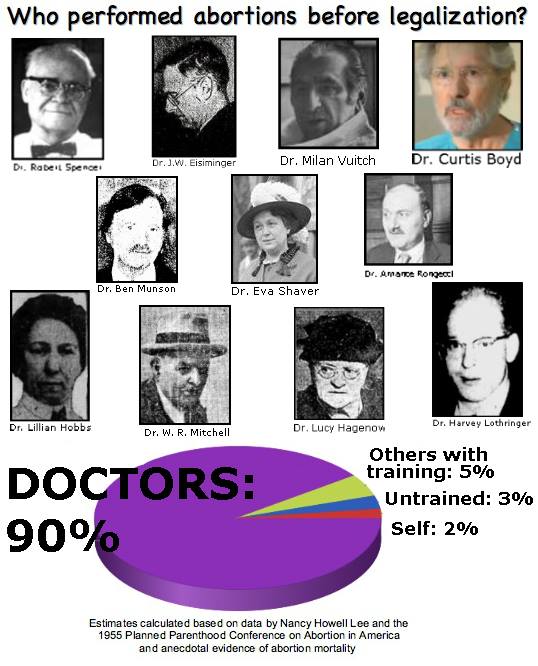
As was the case nationwide before legalization, the majority of Chicago's illegal abortionists were midwives or physicians, though there were the occasional lay abortionists such as Katherine Bajda, identified as a homemaker in the Homicide in Chicago Interactive Database. Despite not being a medical professional, Bajda benefited from Chicago's catch-and-release system of dealing with deadly abortionists.

On January 23, 1929, 22-year-old Edna Vargo died in Chicago from an abortion performed that day, Bajda was held by the Coroner on February 14. On March 15, she was indicted for felony murder in Edna's death. Three days later, while free to ply her trade, Bajda got caught with 25-year-old abortion patient Violet Diancalana dead in her home.


According to genealogical records, Edna was born in Hastetter, PA, the daughter Polish immigrants Fred and Victoria Palarz Komperda and was one of 11 children.

January 23, 1925: No Perp Identified

On January 23, 1925, 34-year-old Kate Radochouski died at Chicago's Lakeside Hospital from complications of an abortion performed that day. 

The Homicide in Chicago database says that she died at the scene of the crime, and that there was an arrest on February 11. But there is no name given for the person arrested. No perpetrator was ever identified.

January 23, 1914: Another Chicago Midwife

According to the Homicide in Chicago Interactive database, 17-year-old Helen Klick, who worked as a domestic servant, died on January 23, 1914, at Cook County Hospital from sepsis, arising from an abortion perpetrated on January 17 by midwife Margaret Wiedemann. Wiedemann, age about 46, was held by the Coroner for murder by abortion, but was acquitted.

Wiedemann had been arrested in May of the previous year for the death of Sophia Wagner. She admitted to having performed the fatal abortion. I've been unable as of yet to determine why she was free to be implicated in Helen's death. The fact that Wiedemann was at large is especially tragic in that she was convicted and sentenced to prison for Sophia's death nearly two years after Helen's death.

January 23, 1944: The Soldier's Sweetheart

Portrait of a smiling young white woman with fine features and dark, shoulder-length hair
Geraldine Schuyler

Geraldine Schuyler, age 20, was a secretary at Matthewson Electric Company in Chicago when she learned that she was pregnant in January of 1944. The father was Geraldine's fiancé, a soldier in the Army Air Forces.


Geraldine turned to her mother, Leah Schuyler, who went with her on January 14 to meet one of Leah's friends, 49-year-old Mrs. Avis Konradt. 

Konradt, a nurse, took them to a rooming house where 79-year-old George E. Fosberg was caretaker. Fosberg was a physician whose license had been revoked in 1930 when he'd gone to prison for bank fraud. Fosberg examined Geraldine and agreed to perform an abortion.

The women returned to the rooming house on January 17. Mrs. Schuyler paid Fosberg $100 (about $1,700 in 2023 dollars), and he took Geraldine and her into the basement for the abortion, accompanied by Konradt.

Geraldine started to become ill on January 20. By the night of Saturday, January 22, she took a sudden turn for the worse and was quickly taken to St. Francis Hospital in Evanston shortly before midnight. At around 2:00 on the morning of the 23rd, she was dead.

Mrs. Schuyler told the police what had happened, and led them to the rooming house. There, police found Fosberg "in the dusty basement of the house, walking thru stacks of his old records as a physician." The police confiscated seven sets of surgical instruments.

Nurse Konradt testified against Fosberg during the trial, admitting that she had witnessed the abortion. 

Fosberg took the stand in his own defense, admitted that the three women had come to him on January 17 to request an abortion. He wept as he said, that he "resented" the request that he perform an abortion. "I suggested that she marry the man. I told her that if she had a baby she would never regret it."

The jury needed only 90 minutes to reach a decision. Fosberg was convicted of manslaughter rather than the more serious charge of murder by abortion. 

The judge had originally sentenced him to serve 14 years in prison. The sentence was deferred while Fosberg tried to get a new trial. The attempt failed. However, Fosberg's attorney argued that due to his client's age, a 14-year sentence was equivalent to a death sentence. Fosberg's sentence was reduced to between one and three years. 

I have been unable to learn anything about the outcome of the charges against the nurse, Avis Konradt. She had been granted a separate trial.

The Schuyler family had moved to the Chicago area from Decatur, Illinois five years earlier. After Fosberg's conviction, her working-class parents returned to Decatur.

Watch Nurse + Doctor = Death on YouTube.

Sources:

January 23, 1926: Doctor Implicated While Already Out on Bail

AI illustration
On the evening of January 21, 1926, 19-year-old Mary Elizabeth Christy lay dying in American Hospital in Johnston City, Illinois. Before her death, she made a statement before witnesses that Dr. James H. Coleman, age 75, had perpetrated a fatal abortion.

According to public records, Mary had an older brother and three younger brothers. Her father, John, was a room boss in a coal mine, according to the 1920 census, and her older brother also worked in a coal mine. Mary's job is listed in her death record as a "room girl," meaning that she did some sort of housekeeping work.

Mary finally breathed her last at 10:45 on January 23. Nobody at the hospital was willing to sign a death certificate, so the coroner was brought in. He conducted an inquest, resulting in the arrest of Coleman.

Coleman had lived and practiced in Carterville, Illinois for four decades. He was out on bail pending trial for another murder charge dating back to 1924, and he had two other non-fatal abortion charges pending. He had managed to post a total of $19,000 bond -- $15,000 for the murder and $2,000 each for the non-fatal abortions. That's the equivalent of nearly $350,000 in 2025. The only mention of those three cases I could find were all just contextual information in coverage about Mary's death.

Coleman asserted that he had never met Mary Elizabeth, and and I can't find any evidence that any of the four cases ever went to trial.


Sources: